
Introduction: why construction plans are often not executed A persistent paradox has been observed in the construction industry for a long time: even well-developed calendar,...
2026.08.20
A persistent paradox has been observed in the construction industry for a long time: even well-developed calendar, network and resource plans regularly demonstrate low feasibility.
Usually, the reasons are found in the planning itself: insufficient detail, errors in calculating labor intensity, inaccuracies in rationing, or unaccounted for external factors. However, in practice, the problem lies deeper.
Calendar and network planning (KSP) should determine when, in what sequence, and with what duration construction and installation work (CMP) is performed.
Resource planning (PR) answers another question: what resources, to what extent and in what time frame are needed to complete these works.
But even together they do not provide an answer to the key question: are all the conditions really created so that the work can be started on time and performed efficiently?
The KSP sets the timing and sequence. Resource planning determines the need for materials, equipment, and personnel. Together, they create a planned model of the desired outcome. However, both tools do not cover and do not take into account all aspects of the organizational and technological preparation of the implementation of the QMS.

As a result, everything is formally ready — the deadlines and resources have been planned. But in practice, it is impossible to start the work. The team is idle, the equipment is not being used, and the deadlines are being shifted.
According to the Construction Industry Institute (CII), the productive time of a construction team (tool-time) averages only 37% of the time spent on the site. Russian practice at individual projects records values of 23–25%. The rest is organizational and technological losses.
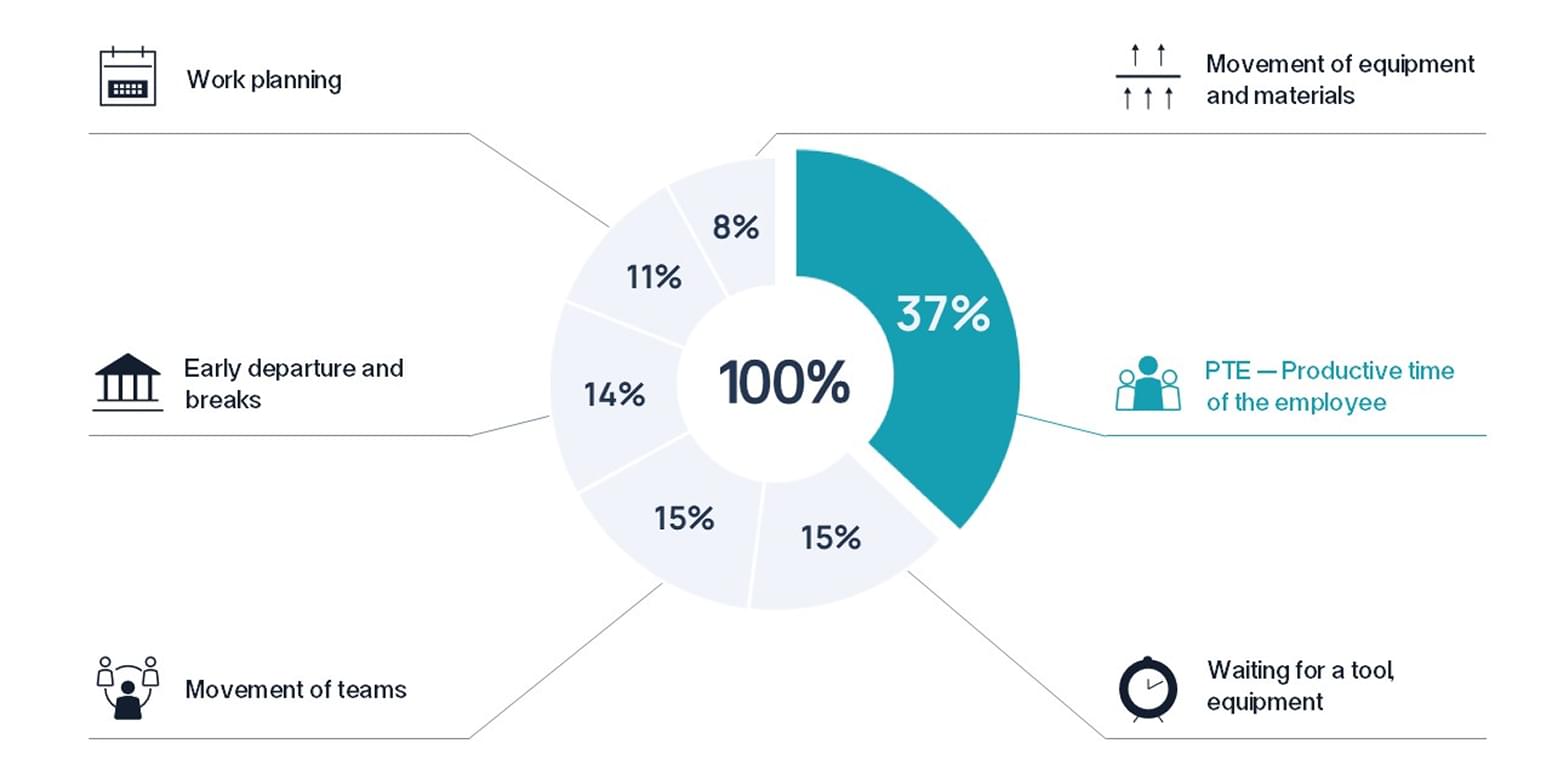
Is to implement the Constraint Management (CM) methodology as a systemic mechanism for proactive organizational and technological preparation of construction and installation works (CIW).
To eliminate conceptual confusion, it is necessary to clearly distinguish between three tools that do not replace but complement each other:
Is a method for modeling the temporal and logical relationships between tasks.
CNP operates only with temporal categories. It does not verify the availability of resources, documentation, tolerances, or the confirmed readiness of preceding stages. The CSP records deviations after the fact (“actual performance is later than planned”), but does not allow them to be prevented. Even the most detailed network schedule does not provide information about why the work did not start: due to the absence of a drawing, material, tolerance, or construction readiness. Resource planning (RP) mainly covers material and technical support, labor resources, machinery and equipment, and finances.
The need and records the use of the resource, but does not confirm that all conditions for using the resource have been met by the time work begins. Typical gaps:
Is a methodology for proactively identifying, tracking, and eliminating obstacles that block the start or completion of construction work. It answers the question: “What exactly is preventing work from starting or being completed?”. Functions of limit management:
Constraint management does not replace either calendar‑network planning or resource planning. It complements them by adding the missing link – verification of the actual readiness to carry out the construction work.
| Parameter | Schedule network planning (SNP) | Resource planning (RP) | Limit Management (LM) |
|---|---|---|---|
| Control object | Temporal parameters (dates, durations, relationships) | The volume and range of resources (materials, equipment, personnel) | Organizational and technological conditions (documentation, tolerances, readiness) |
| Principle | Reactive – detects deviations from the plan | Reactive – detects deviations from the plan | Proactive – eliminates obstacles in advance |
| Questions | “When?”, “In what sequence?” | “What and how much is needed?”, “When to place it?” | “What could hinder it?”, “Who will resolve it and when?”, “Are all the conditions met?” |
| Information status | Planned (dates) | Planned (requirement) | Actual (confirmed readiness) |
| Result | Schedule (model) | Resource plan | Restriction removal plan (RRP) |
KSP and PR create a plan. Constraint management ensures the feasibility of this plan. Any calendar and resource schedule without a concurrently operating constraint management system will be merely a set of assumptions, not a document that guarantees the timely production of construction and installation works.
The preparation of Gantt charts must be carried out in accordance with the requirements established by the organization. Such requirements are formulated in the standard or methodology for Gantt chart planning and project control. As a rule, the methodology is fixed the following provisions:

A constraint is a specific and verifiable condition, without which it is impossible to legally, safely, and technologically correctly begin or complete construction and installation work.
Determined by a countdown from the start date of the construction and installation works, taking into account regulatory and contractual deadlines, for example, working documentation — within 60 days, materials — within 30 days, equipment — within 10–20 days).
Determined by a countdown from the start date of the construction and installation works, taking into account regulatory and contractual deadlines, for example, working documentation — within 60 days, materials — within 30 days, equipment — within 10–20 days).
The limitation refers to the unified classification (11 groups), which allows for their systematic management.
As a result of the development of the CSG, a clearly structured plan appears with the allocation of responsibilities and a clear, achievable result of each package of work. A detailed plan shows the need for resources, the disbursement of funds, as well as a monthly-daily schedule of work, indicating the main physical volumes.

The entire set of potential constraints is divided into 11 groups, covering the full life cycle of preparing and carrying out construction and installation work.
| № | Group | Typical examples of content |
|---|---|---|
| 01 | Working documentation | A set of drawings for the scope of work has been approved, submitted for production, and there are no conflicts with related sections. |
| 02 | Organizational and technological documentation | The work plan, technological maps, and projects for crane operations have been developed and approved; the personnel have been informed. |
| 03 | Materials and equipment | The specification has been drawn up, the order has been completed, delivery to the on-site warehouse, entrance control has been completed, certificates and passports are available |
| 04 | Machines, mechanisms, tools, accessories | The applications have been confirmed, the equipment is on site, the staff is certified, the scaffolding has been assembled and inspected, and the formwork has been received |
| 05 | Occupational safety and industrial safety | The briefings have been conducted (recorded in the logs), PPE has been issued, work permits have been issued, and safety barriers and signs have been installed. |
| 06 | Quality requirements | Operational control checklists have been issued, the control procedure has been defined, and access for construction control has been provided. |
| 07 | Staff readiness | The number and qualifications of staff have been calculated, the team has been assigned (by order), certificates and permits have been checked, and passes have been issued. |
| 08 | Construction readiness | Geodetic marking has been carried out (marks, axes), previous work has been completed and accepted according to the records of hidden work, passageways and lighting have been provided. |
| № | Group | Typical examples of content |
|---|---|---|
| 09 | Taxiway and taxiway changes | Requests for changes have been issued, the author’s supervision has confirmed, and changes have been made to the documentation (author’s sheets) |
| 10 | Completion of works | The physical volumes have been completed, the actual labor costs, machine hours, and material consumption have been recorded and transferred to the KSP service. |
| 11 | Executive documentation | The general and special work journals, as well as the certificates of inspection of hidden works, as-built geodetic diagrams, test reports, passports, and certificates have been submitted to the archive. |
Each type of construction and installation work (construction of monolithic reinforced concrete structures, installation of metal structures, mechanized soil excavation, etc.) is accompanied by a standard checklist containing a list of coded restrictions with normatively established timeframes for removal.
The constraint management process consists of sequential cycles with fixed planning and control horizons.
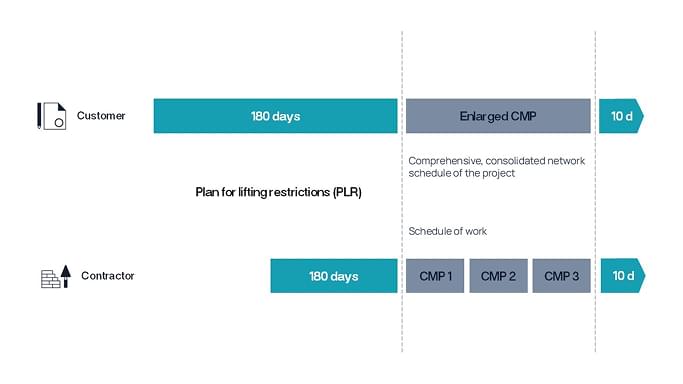
It is carried out in the form of an extended working meeting. Participants:
How the work proceeds: the team sequentially goes through all the planned types of construction and installation work (stages, structural elements). For each of them, all 11 groups of restrictions are checked using a standard checklist.
All identified obstacles are recorded, both on the part of the customer and on the part of the general contractor and subcontractors. Even a potential restriction cannot be overlooked.
A meeting protocol with a complete list of restrictions, including their codes, groups, preliminary deadlines for removal, and responsible parties.
After the meeting, based on the protocol, the restriction management coordinator transfers all restrictions to a single register (the PLAN‑R digital environment). For each restriction, the following are determined
The plan for removing restrictions is approved by the project manager (from the customer) and the construction manager (from the general contractor). All responsible parties receive extracts from the PSO.
Monitoring of PSO implementation is carried out weekly on a fixed day with the participation of all responsible parties.
2–3 days before the meeting, responsible parties send reports to the coordinator regarding their restrictions: current status, reasons for deviations, corrective measures, and an updated forecast.
The plan for removing restrictions is approved by the project manager (from the customer) and the construction manager (from the general contractor). All responsible parties receive extracts from the PSO.
An updated PSO and a protocol with a list of activities and escalations.
The coordinator, together with the engineering department engineers of the customer and the general contractor, checks:
If the check is passed, a permit is issued to include this amount of work in the monthly (weekly) plan and allow the team to enter the facility.
It is strongly discouraged (in fact, prohibited) to start the CMP if there is at least one non—lifted start restriction.
After completion of the volume work, the following actions are performed:
After confirmation, the restrictions are transferred to the “removed” status, and the PSO for this volume of work is closed.
As a result of the development of the CSG, a clearly structured plan appears with the allocation of responsibilities and a clear, achievable result of each package of work. A detailed plan shows the need for resources, the disbursement of funds, as well as a monthly-daily schedule of work, indicating the main physical volumes.


For the successful implementation of the UR, it is important to clearly define the roles and areas of responsibility. Below are the key roles and their main responsibilities in the constraint management processes.
| Role | Side | Main responsibilities in the MA processes |
|---|---|---|
| Coordinator for Constraint Management (CUO) | Technical customer | Organization of identification meetings, management of PSOs, status monitoring, moderation of weekly meetings, report on “red” restrictions to management |
| Project manager | Technical customer | Approval of the PSO, resolution of disputes, removal of restrictions on the part of the customer (documentation, permits, access to construction control) |
| Head of Construction | General Contractor | Ensuring the lifting of restrictions by the general contractor (materials, equipment, personnel, etc.), coordination of PSOs, escalation of problems |
| VET Engineer (customer/General contractor) | Both sides | Control of the readiness of working and organizational-technological documentation, verification of completeness, participation in meetings. |
| Construction control engineer | Technical customer | Confirmation of the completion of preceding work (records of hidden works), verification of quality constraints. |
| Occupational safety and health engineer (customer / general contractor). | Both parties | Confirmation of compliance with safety requirements (briefings, work permits, personal protective equipment, guards). |
| Chief mechanic. | General contractor | Ensuring the availability and proper functioning of machinery and equipment, confirming requests |
| Supply specialist | General contractor | Tracking material deliveries, conducting incoming inspection (together with the construction control department) |
| Work supervisor (foreman) | General contractor / subcontractor | Providing information about the actual readiness of the work area, conducting visual inspections, providing feedback on restrictions |